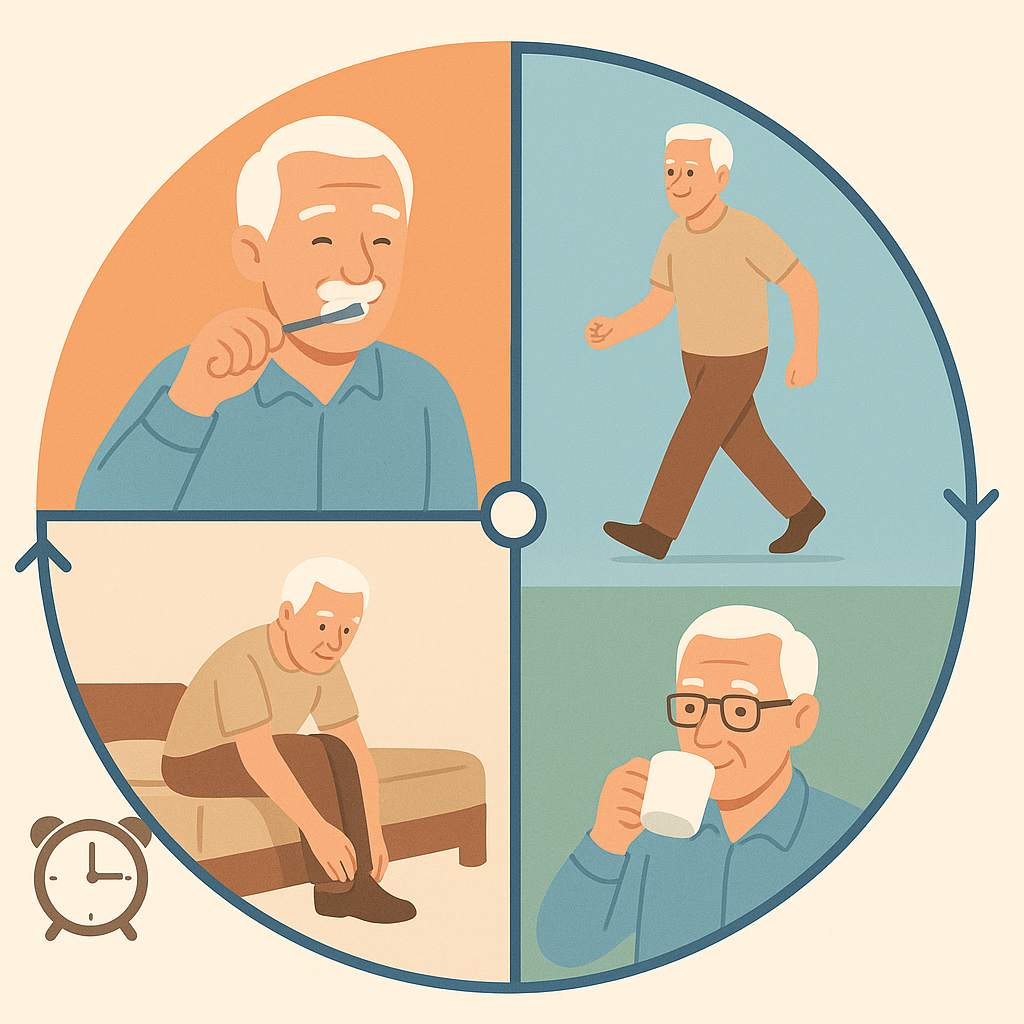
Wellbeing is about more than just physical health—it encompasses your mental clarity, emotional balance, social connections, sense of purpose, and overall quality of life. The good news is that simple, consistent daily habits can significantly enhance wellbeing and help maintain independence and vitality, which is especially relevant to older adults. As we age, establishing a regular daily routine becomes increasingly important. Routines provide structure, reduce stress, help maintain cognitive function, and give a sense of control and purpose. They also make it easier to ensure one is addressing all aspects of his/her wellbeing each day.
Oral Care as a Key Component of Daily Routine
Thus, incorporating self-care and oral care into daily routine is crucial. Maintaining good oral hygiene is more than just keeping your teeth clean—it’s a vital health intervention that can significantly impact cognitive health and overall wellbeing. The benefits of maintaining daily oral health routine go beyond someone`s smile.
Oral Health and Cognitive Function
Research shows that poor oral health, particularly gum disease, may increase the risk of cognitive decline and dementia, making daily oral care routines essential risk factors we can actively manage. Additionally, poor oral hygiene can contribute to inflammation and infections that may accelerate several health issues. For older adults already living with dementia, maintaining oral health becomes even more critical to prevent secondary complications related to swallowing difficulties and eating problems, which can severely affect nutrition and quality of life. Besides, beyond physical health, oral hygiene profoundly influences wellbeing and social engagement. A healthy smile, clean teeth, and fresh breath boost confidence and self-esteem, encouraging people to remain socially active and connected with their communities.
The Role of Appearance in Wellbeing
How our face looks and our ability to smile and eat comfortably impacts our wellbeing.
Oral Health Prevention Across Ages and Dementia Stages
Prevention is relevant at all ages, but also at all stages of dementia: from primary prevention to tertiary prevention that supports function and quality of life in people living with dementia.
COMFORTage “Mouth and Mind” Guide
Within Pilot 7 “Mouth and Mind” of the COMFORTage project, partners have developed a guide as an educational material to help older adults establish and maintain effective daily oral health routines. The guide was developed according to people`s needs with keeping in mind person centred approach.
In developing educational brochures for older adults with cognitive decline, specific design principles were applied to ensure maximum accessibility and usability, following international standards ISO/TR 25555:2024 and ISO/TR 22411:2021. The design process focused on five key elements: typography, colour schemes, textual content, visual elements, and layout structure.
Step-by-Step Oral Care Instructions
The guide contains infographics with clearly practical guides with step-by-step instructions to brushing with a toothbrush, and also addresses some common questions. Then, it introduces brushing with a sonic toothbrush. In order to facilitate and to regain independence, the guide also shows how to maintain oral health with an automatic brush; i.e. robotic toothbrush. Research shows that early and mild cognitive decline often leads to drastic deterioration in oral health, suggesting that automatic toothbrushes could help maintain oral hygiene for those experiencing cognitive challenges. However, step-by-step infographic is often needed by people with the condition. Further, while toothbrushes can help with cleaning natural teeth, individuals with partial dentures still need to maintain proper denture cleaning routines in addition to brushing their remaining natural teeth, and they must also clean between any remaining natural teeth to prevent decay and gum disease. Therefore, the guide also contains how to clean the spaces between the teeth and shows procedures to cleaning dentures. The materials are therefore suitable to different needs for older adults and support their daily routine and practice.
Gamification and Motivation in Oral Health
Combining design elements specifically tailored for older adults with cognitive decline with gamification approaches creates an engaging framework that can improve motivation for oral health maintenance. This integrated approach addresses both the cognitive accessibility needs of this population while leveraging the intrinsic motivational power of game mechanics to transform routine oral care tasks into achievable, rewarding experiences that promote consistent daily practice.
Universal Use and Caregiver Training
Even though, these oral hygiene instructions were tailored for older adults with cognitive decline, they are suitable for people of all ages, cognitive and medical conditions. They can also be used as training tool for caregivers.
Piloting and Validation
These resources will be implemented and co-validated during the piloting phase, ensuring they truly meet the needs of older adults and provide practical, accessible guidance for maintaining both oral health and cognitive wellbeing.
**Article written by VSTE & MFU, a key partner in the COMFORTage project.