
COMFORTage Virtual AI-based Healthcare Platform: Architecture Enhancements and Integration Activities
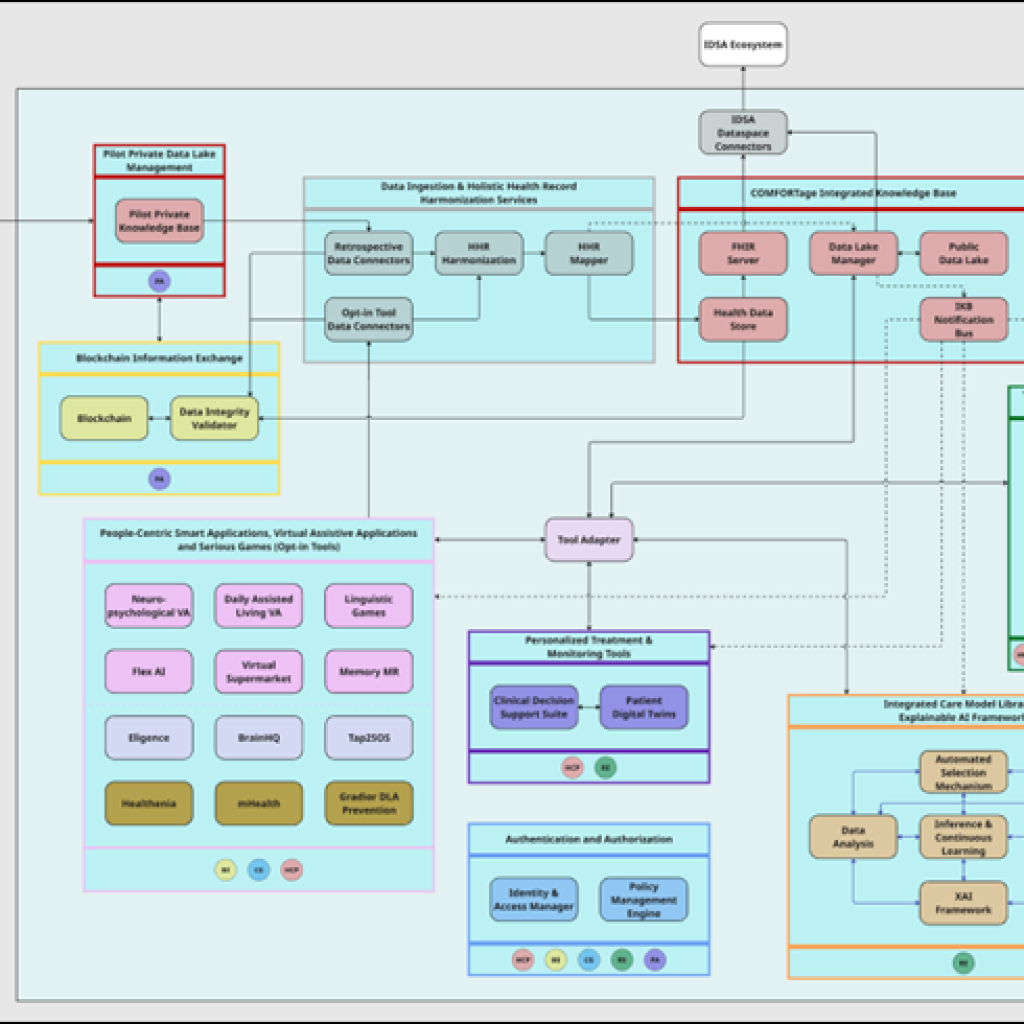
During the second year of the project (Jan-Dec 2025), COMFORTage’s Virtualized AI-based Healthcare Platform (VHP) underwent several revisions and updates in order to accommodate newly available technical details for several of its core and optional components. The Cyprus University of Technology (CUT) – leading task T2.5 – together with the technical partners of the consortium, introduced several supportive mechanisms and engines to the core VHP functional structure, consolidating the platform as a modular, scalable and interoperable microservice-based architecture. The revised architecture (Figure 1) portrays how both clinical data and non-clinical data flow through the platform, and also how AI analytics, decision support and user-facing applications are orchestrated across layers.
Key Updates to the VHP System Architecture
Refinements to components were necessary in order to ensure that the VHP continues to adequately meet the needs of its users and stakeholders. Based on feedback, pilot study requirements and evolving component constraints, the main updates to the architecture include:
-
Data Source Connectors and Tool Adapter
The importing and storage of data in COMFORTage VHP now distinguishes between clinical/behavioural data and non-clinical data. If a pilot site has retrospective clinical data, these are uploaded to the pilot’s Private Knowledge Base (PKB), from where the Retrospective Data Connectors for each pilot are responsible for invoking the Holistic Healthcare Record (HHR) harmonisation process. Clinical data generated through beneficiaries’ use of and interaction with the available Opt-in Tools are ingested into the platform through the Opt-in Tool Data Connectors. In both cases, data are cleaned, normalised, standardised and transformed into FHIR resources. Subsequently, the HHR Mapper transforms them using an equivalent HHR relational model in order for the data to be stored in the project’s IKB. On the other hand, non-clinical data that is generated by Opt-in Tools and other components are stored in the platform in a different manner, as no harmonisation is required. Instead, each Opt-in Tool has its own unique tool adapter, via which any non-clinical data generated by them is stored in the platform’s Data Lake.
-
Integrated Knowledge Base
COMFORTage’s IKB components function as the central data repository responsible for all the data management activities of the VHP. In its core lies a novel relational database with innovative capabilities suitable for the purposes of healthcare analytics, and as well as a distributed file system that serves the purposes of the Public Data Lake of the VHP. The Health Data Store saves pilot data that have been harmonised and transformed into FHIR resources in a structured (relational) format. The FHIR Server is responsible for controlling the access to this data by other VHP components. It provides a standard HAPI-FHIR OpenAPI interface for accessing and querying FHIR data stored in the underlying database, which is used as its backend data management system. All other types of data (e.g., gameplay data, prediction results) are stored in the VHP’s Public Data Lake. Access to the Public Data Lake is handled by the Data Lake Manager module.
-
Automated Selection Mechanism
This is a supportive element of the ICML and XAI Framework. Its purpose is to orchestrate the different pipelines of the components to select the appropriate methods and parameters according to the type of data and/or predictive analysis requested.
-
Data Integrity Validator
This is an auxiliary feature of the BIE component. It is responsible for ensuring that all data written in the IKB through the data ingestion pipeline is accurate, unaltered and cryptographically verifiable, thereby safeguarding the reliability and auditability of the data stored in the VHP.
Furthermore, as part of task T2.6 activities, several major technical building blocks were developed and integrated with the VHP. Keycloak-based single sign-on and role-based access control mechanisms were implemented as part of the Identity and Access Manager (IAM). Data Source Connectors and APIs were developed for the data ingestion pipeline. The Data Store, FHIR Server, Data Lake Manager components of the Integrated Knowledge Base (IKB) were set up for the platform data repositories. A Hyperledger Besu client was configured for integrity anchoring and consent versioning within the Blockchain Information Exchange (BIE). Moreover, Clinical Decision Support Suite (CDSS), Patient Digital Twins (PDT) components, Integrated Care Model Library (ICML) and explainable AI (XAI) Framework components all commenced their integration process. A full report of the updates to the architecture and VHP integration can be found in Deliverable D2.9 – “Reference Architecture and Integration of VHP Platform II”, delivered in December 2025 (month 24 of the project).
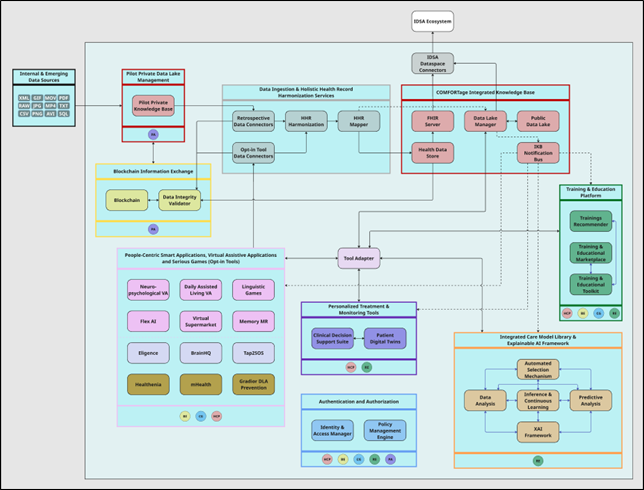
Current VHP Architecture: A Mature, Multi-Layered Platform
The current version of COMFORTage’s VHP architecture provides the blueprint of a mature, multi-layered platform that is now technically implementable and aligned with real clinical workflows across the 13 pilots. The VHP has moved beyond a conceptual design towards implementation of a concrete, integrated platform in which data ingestion, harmonisation, storage, AI analytics, clinical decision support and user-facing applications operate as a coherent ecosystem.
At the data layer, the combination of Data Source Connectors, HHR Harmonisation, HHR Mapper and the IKB provides a unified pipeline for bringing heterogeneous clinical and behavioural data, as well as non-clinical data into a common representation, ready for AI-driven analyses and cross-pilot reuse. The Data Integrity Validator and Blockchain Information Exchange strengthen trust, integrity and auditability along this pipeline, without compromising GDPR compliance.
At the intelligence layer, the ICML and XAI Framework, supported by the Automated Selection Mechanism, offer a shared infrastructure for deploying, explaining and maintaining predictive models across pilots, while the CDSS and PDTs deliver these insights in a clinically meaningful form. Together with the Training and Educational Platform (TET) and a rich portfolio of Opt-in Tools, the platform can support personalised interventions, multimodal monitoring and user empowerment for both dementia and frailty.
From a governance and usability perspective, the IAM component and identified user journeys show that access to VHP tools and data can be managed consistently across heterogeneous pilots and user groups. The alignment with the Digital Healthcare Reference Model (DHRM) devised in task T.4 confirms that COMFORTage’s architecture is not only project-specific but can act as a reusable reference for AI-enabled, EHDS-compatible digital health platforms.